Books TC
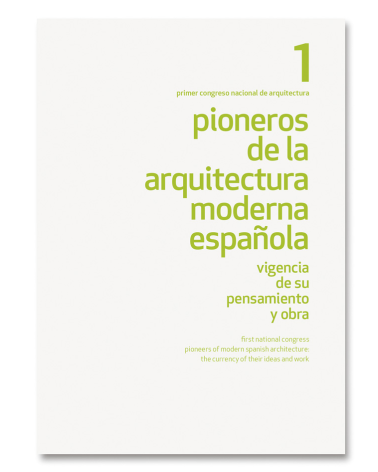
Pioneers (1). Vigencia de su pensamiento y obra
Fundación Alejandro de la SotaThe 1st Pioneers of Modern Spanish Architecture National Congress, organized by the Alejandro de la Sota Foundation under the title “The Currency of their Ideas and Work”, is devoted to the generations of Spanish architects born around the 1910s and 1920s. Trained amid the economic hardship and cultural isolation of the post-war period, they assimilated modern ideals in an introspective, self-taught way to develop a personal poetics adapted to the country’s demands, writing from the 1950s onwards one of the most brilliant chapters of twentieth-century Spanish architecture.
The congress is structured along two lines of reflection — the currency of their ideas, through their writings, interviews and lectures, and the currency of their work — looking back in order to move forward. The papers analyse works and figures such as Luis Cubillo and the Canillas church, Juan de Haro, the Spanish Pantheon in Rome by García de Paredes, Luis Peña Ganchegui, and Coderch, Fisac and De la Sota, together with articles by keynote speakers María Teresa Muñoz, Josep Llinás, Francisco Alonso de Santos and José Manuel López-Peláez.
This bilingual publication compiles the selected papers and the articles on the debates and, in its annexes, the detailed congress programme and the list of contributions published in the digital proceedings.
- Collection
- Pioneers of Modern Spanish Architecture
- Number
- 1
- Language
- Spanish/ English
- Size
- 17 X 24 cm
- Format
- Soft Cover
- Page number
- 312
- ISBN
- 978-84-943475-2-8
- Year
- 2018
These architects began their careers in a climate of post-war economic hardship and cultural isolation at the end of a civil conflict that almost completely froze Spain’s ephemeral modernity, which had begun in the late 1920s.
In this difficult context, the only possible way forward seemed to be an introspective, self-taught approach that could absorb the Modern ideals in an individual, intuitive way, to be used by our architects to develop their own personal poetry, adapted to the country’s needs.
Despite the hostile environment and the acute resource shortage, these architects’ enthusiasm, their sense of social responsibility, their commitment to the profession and their innovative spirit led them to write one of the most brilliant chapters in the history of 20th century Spanish architecture.
The principles of modernity were transformed and adapted to the country’s social and cultural situation through the highly individualistic, heterogeneous work built by these authors from the 1950’s onwards.
Approaching the theme from this perspective, this Congress invites participants to undertake a collective reappraisal of these masterworks and the ideas of their authors, and at the same time, analyze their relevance to the search for solutions to the challenges in today’s socio-economic and technological context.
In short, the aim is to look back in order to gain forward momentum.
You might also like